
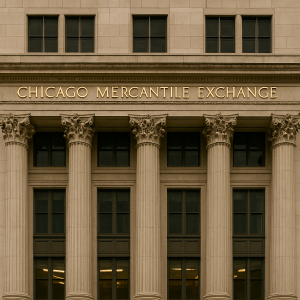
Chicago Mercantile Exchange (CME): A Pillar of U.S. Financial Markets
Chicago Mercantile Exchange (CME) is a leading U.S. derivatives exchange offering futures and options on commodities, currencies, and equity indexes. Learn how the CME shapes global financial markets. Discover the history of the CME, from its founding in 1898 to becoming the world’s largest derivatives marketplace. Learn key milestones and innovations.
📌 What Is the CME?
CME is one of the largest and most influential derivatives marketplaces in the United States. It provides a platform for trading futures and options across commodities, interest rates, currencies, and stock indexes, playing a critical role in global finance.
Founded in 1898 as the Chicago Butter and Egg Board, the CME has evolved into a leading derivatives exchange headquartered in Chicago, Illinois. It is now part of CME Group, which also includes CBOT, NYMEX, and COMEX.
✅ CME allows businesses, investors, and traders to hedge risk, speculate, and manage financial exposure efficiently.
📌 Key Services and Products
The CME offers a wide range of financial products, including:
- Futures Contracts – Agreements to buy or sell assets at a future date, covering commodities, financial instruments, and indexes.
- Options on Futures – Contracts that provide the right, but not the obligation, to buy or sell futures.
- Interest Rate and Currency Trading – Hedging tools for global markets.
- Equity Index Products – Including contracts based on the S&P 500 and NASDAQ indexes.
👉 These services allow participants to manage price risk and invest strategically in global markets.
📌 Why the CME Is Important
- Market Stability: Helps businesses hedge against price fluctuations in commodities and financial instruments.
- Economic Indicator: CME trading activity reflects market expectations and investor sentiment.
- Global Influence: Trades impact commodities and financial markets worldwide.
- Innovation: Pioneered electronic trading platforms, allowing faster and more efficient transactions.
📊 For example, CME trading volumes provide insights into trends in agriculture, energy, finance, and more.
📌 CME in the Digital Age
CME has embraced technology with its CME Globex platform, enabling 24/7 electronic trading. This allows global participants to access markets from anywhere, enhancing liquidity and transparency.
The History of the CME: Key Milestones
CME is a cornerstone of the U.S. financial system. From its early beginnings as a small commodity board to becoming a global derivatives powerhouse, the CME has played a vital role in shaping modern markets.
📌 Origins of the CME (1898)
- Founded in 1898 as the Chicago Butter and Egg Board.
- Initially focused on trading agricultural commodities like butter, eggs, and other farm products.
- Provided a centralized marketplace for Chicago-area farmers and traders.
✅ CME began in 1898 as the Chicago Butter and Egg Board, providing a central marketplace for agricultural products.
📌 Early 20th Century Expansion
- 1919: The Chicago Butter and Egg Board becomes the Chicago Mercantile Exchange.
- Expanded trading to include livestock, dairy, and other commodities.
- Established rules and procedures to ensure transparent and regulated trading.
📌 Mid-20th Century Innovation
- 1960s–1970s: Introduction of financial futures alongside commodity trading.
- 1972: Launch of the first currency futures contracts, expanding CME’s reach into global finance.
- 1980s: Pioneered electronic trading systems, setting the stage for modern market infrastructure.
📊 These innovations positioned CME as a global leader in derivatives markets.
📌 Formation of CME Group and Modern Era
- 2007: CME merges with CBOT (Chicago Board of Trade), forming the CME Group.
- 2008–2010: Acquisitions of NYMEX and COMEX, making CME Group the largest derivatives marketplace in the world.
- 2010s–Present: Expansion of electronic trading, risk management products, and global market access.
✅ CME evolved from a regional commodity exchange to the world’s largest derivatives marketplace through mergers, innovation, and electronic trading.
📌 Why CME’s History Matters
- Market Leadership: CME’s innovations have set industry standards for derivatives trading.
- Economic Impact: Provides businesses, investors, and governments tools to hedge risks globally.
- Global Reach: Trading activity influences commodities, currencies, interest rates, and stock indexes worldwide.
🔎 Quick Answers
What is the CME?
CME is a U.S.-based derivatives exchange offering futures and options contracts on commodities, financial instruments, and equity indexes.
When was the CME founded?
CME was founded in 1898 as the Chicago Butter and Egg Board and later became a leading derivatives marketplace.
✅ Conclusion
Chicago Mercantile Exchange is more than a trading floor — it is a cornerstone of U.S. and global financial markets. By providing futures, options, and risk management tools, the CME empowers businesses and investors to navigate complex markets efficiently. CME has transformed over more than 120 years from a small agricultural board to a global financial powerhouse. Its history of innovation, expansion, and leadership continues to shape U.S. and global financial markets. For more detailed information about CME, you can visit its official web site. Please also feel free to contact us on any business issue and our services, With over 25 years of expertise, knowledge, and experience in Business Law, we are here to help you. Additionally, you can explore the books of our Founder, Dr. Soner Altaş, in the field of Commercial Law, or take a closer look at Tacirsoft Legal Information System — Turkey’s first and only legal database dedicated to Turkish Corporate Law and Organized Industrial Zones Law.